![Bedrock_Learning_Logo_Mark_Reverse_RGB_1920px@72ppi.png]](https://help.bedrocklearning.org/hs-fs/hubfs/Bedrock_Learning_Logo_Mark_Reverse_RGB_1920px@72ppi.png?height=50&name=Bedrock_Learning_Logo_Mark_Reverse_RGB_1920px@72ppi.png)
To read more about using sequencing in your school's Bedrock Mapper content, click here.
TIP: To jump to the most applicable content, click below...
What is sequencing?
Sequencing is a method of ordering learning. It allows teachers to plan which knowledge learners will encounter within a certain period. It forms part of a holistic approach to planning lessons, where knowledge is introduced and consolidated seamlessly.
“[Sequencing] gives [learners] the skills and the knowledge in the right order from Nursery to Year 6 within each subject.” - Caroline Pudner, Cornerstones Education.
Why is sequencing vocabulary important?
Sequencing vocabulary supports the teaching of content knowledge and subject-specific skills. By sequencing vocabulary instruction, teachers can provide explicit instruction on Tier 2, and Tier 3 terms learners need to know to grasp a new concept or topic. This is crucial for overall attainment across the curriculum.
The Ofsted framework of the 3 I’s - Intent, Implementation and Impact - mentions sequencing as a crucial component of teaching with intent, involving addressing learners with the highest level of need and delivering differentiated, ambitious content for every student.
To ensure that topics challenge learners while remaining accessible, sequencing and pre-teaching vocabulary are crucial.
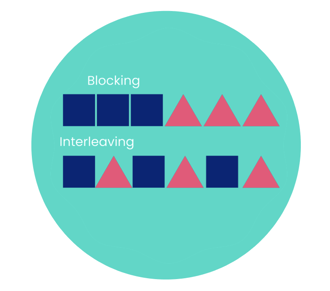 In addition to this, sequencing vocabulary instruction allows teachers to interleave learning in a way time does not allow in the classroom. Vocabulary from one topic can be scheduled and recapped while another is taught, providing opportunities for revision and ensuring long-term retention. Thanks to sequencing, learning is constant for all topics, even while one is being focused on in the classroom.
The two main types of sequencing are interleaving and blocking.
Using interleaving when sequencing
Interleaving is the mixing and alternating between ideas, concepts or skills when learning. Interleaving boosts learning by mixing closely related topics and challenging students to compare and contrast.
Interleaving works because it encourages discrimination learning (spotting differences between similar things). It also involves remembering similarities between different things, providing more 'anchor points' for students to hook information.
Interleaving also involves the benefit of spacing each time the information is revisited. It helps ingrain and cement it into our long-term memory.
Continually retrieving the appropriate information when interleaving can strengthen neural connections, which is better for long-term memory retention.
Example: In Bedrock Mapper, a science teacher could sequence five words from 'Earth,' five words from 'Acids and alkalis,' and five words from 'Rates of reaction.' Bedrock's reteaching algorithm also ensures interleaving.
Use blocking when sequencing
Blocking is when learners study one topic fully before moving on to another. This is what often happens when learners revise the night before an exam. However, this means that connections between topics still need to be made.
Research from the Sutton Trust report tells us that learning in a single block can create better immediate performance and higher confidence. Still, interleaving with other tasks or topics leads to better long-term retention and transfer of skills.
TIP: To further encourage learners to revisit past content, vocabulary can be sequenced in blocks separate from that taught in the classroom. For example, if your class is completing a focus on rivers, then the vocabulary assigned in Bedrock Mapper could be on coasts.
This encourages learners to revise previously taught knowledge and make links to the current topic, encouraging rich subject expertise in every discipline.